Biophilia in Practice: From Design Theory to Everyday Impact

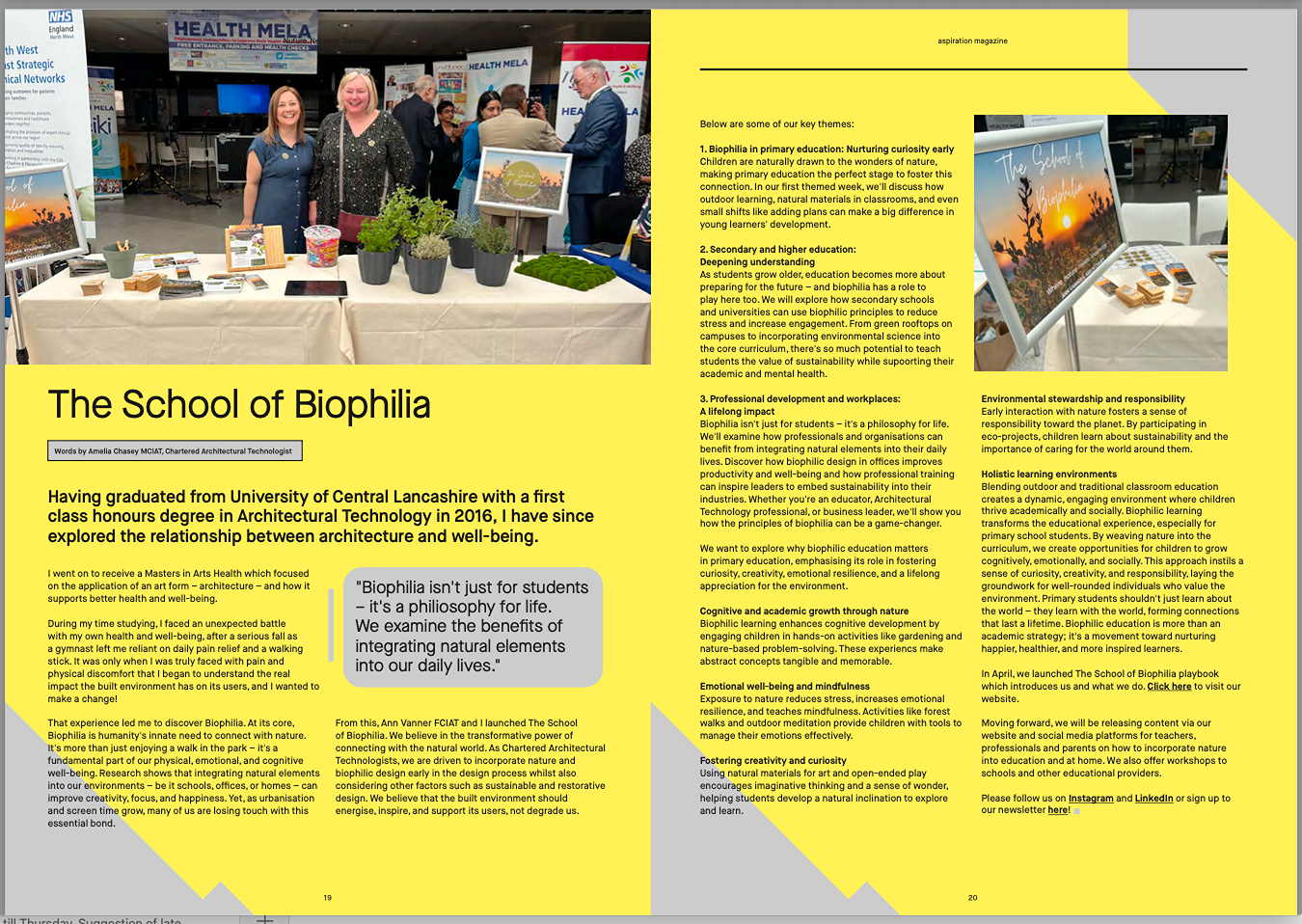
We’re pleased to share that the School of Biophilia has been featured in the Summer 2025 issue of Aspiration Magazine. The article, written by Amelia Chasey MCIAT, Chartered Architectural Technologist, highlights the growing relevance of biophilic design across education, health, and the built environment.
The feature offers an overview of how biophilic thinking — the integration of natural elements and systems into our built environments — can create measurable benefits in learning settings, workplaces, and community infrastructure. The School of Biophilia is built on this approach, combining professional practice, research, and lived experience to explore how spaces can better support well-being.
The School of Biophilia: Background
The School of Biophilia was founded on the principle that architecture and design can actively support physical and mental health. Amelia’s background in Architectural Technology and Health, coupled with personal experiences of recovery and healing, shaped a practical approach to integrating biophilic principles into education and design.
Rather than positioning biophilia as an abstract concept, we treat it as a toolkit. One that can be applied in classrooms, offices, and public spaces to promote well-being, improve focus, reduce stress, and support healthier learning and working environments.
Themes from the Feature
The article in Aspiration Magazine outlines five key areas where biophilic principles are currently being applied and tested:
1. Early Years and Primary Education
Nature-based learning environments can help young children develop curiosity, calmness, and social-emotional regulation. Even small changes — such as indoor planting, access to natural light, or outdoor play — can have a significant impact.
2. Secondary and Higher Education
As mental health issues rise among young people, the role of environment becomes even more important. The School of Biophilia looks at practical ways to create calmer, more engaging learning environments — including the use of natural materials, sensory design, and green spaces.
3. Workplace Design
Biophilic design is gaining traction in office and professional settings, where employers are recognising the connection between environment and staff well-being. Natural lighting, ventilation, views, and plant life are now being considered not just aesthetic choices, but elements of occupational health.
4. Environmental Education
Learning environments that reflect sustainability values can help children and young people engage with climate and ecological issues more meaningfully. The spaces we teach in should reinforce the principles we’re teaching.
5. Holistic and Inclusive Design
Biophilic environments often benefit neurodivergent learners and those with sensory processing needs. These aren’t niche interventions — they support broader inclusion by reducing overstimulation and improving focus.
Why This Work Matters
Biophilic design isn’t about decorating with plants — it’s about rethinking how spaces are used and experienced. There’s growing evidence that exposure to natural elements can lower stress, support immune function, improve concentration, and increase motivation in both learners and professionals.
The School of Biophilia isn’t offering a one-size-fits-all solution. Instead, it supports flexible models that can be adapted to local context — whether that’s a primary school, a health centre, or a workplace. The aim is to make this work accessible and implementable.
A Real-World Example
The images featured in the Aspiration piece shows the School of Biophilia’s stand at a local Health Mela event. The display included resources for educators, examples of sensory tools and natural materials.
This kind of outreach is a key part of the School’s mission: showing what’s possible, not just talking about it.
Next Steps
We’re currently developing professional training materials, co-design projects with schools, and evidence-based case studies. We’re also working with public sector partners to look at how biophilic principles can be integrated into planning and procurement processes.
If you're working in education, design, healthcare, or community development and want to explore practical ways to implement biophilic approaches, we’re open to collaboration.
You can find the full article in the Summer 2025 edition of Aspiration Magazine
To change the appearance of a block, such as the way in which it is laid out and the width of its columns, click on the Change Layout button on the block toolbar, to the right of each block. Additional elements can be added to the block by clicking the Add Element + icon displayed when moving your cursor within the block. You can delete an element (e.g. a button) by clicking it and then clicking the bin icon.
Comments