Biophilila Shift Week 01 of 12
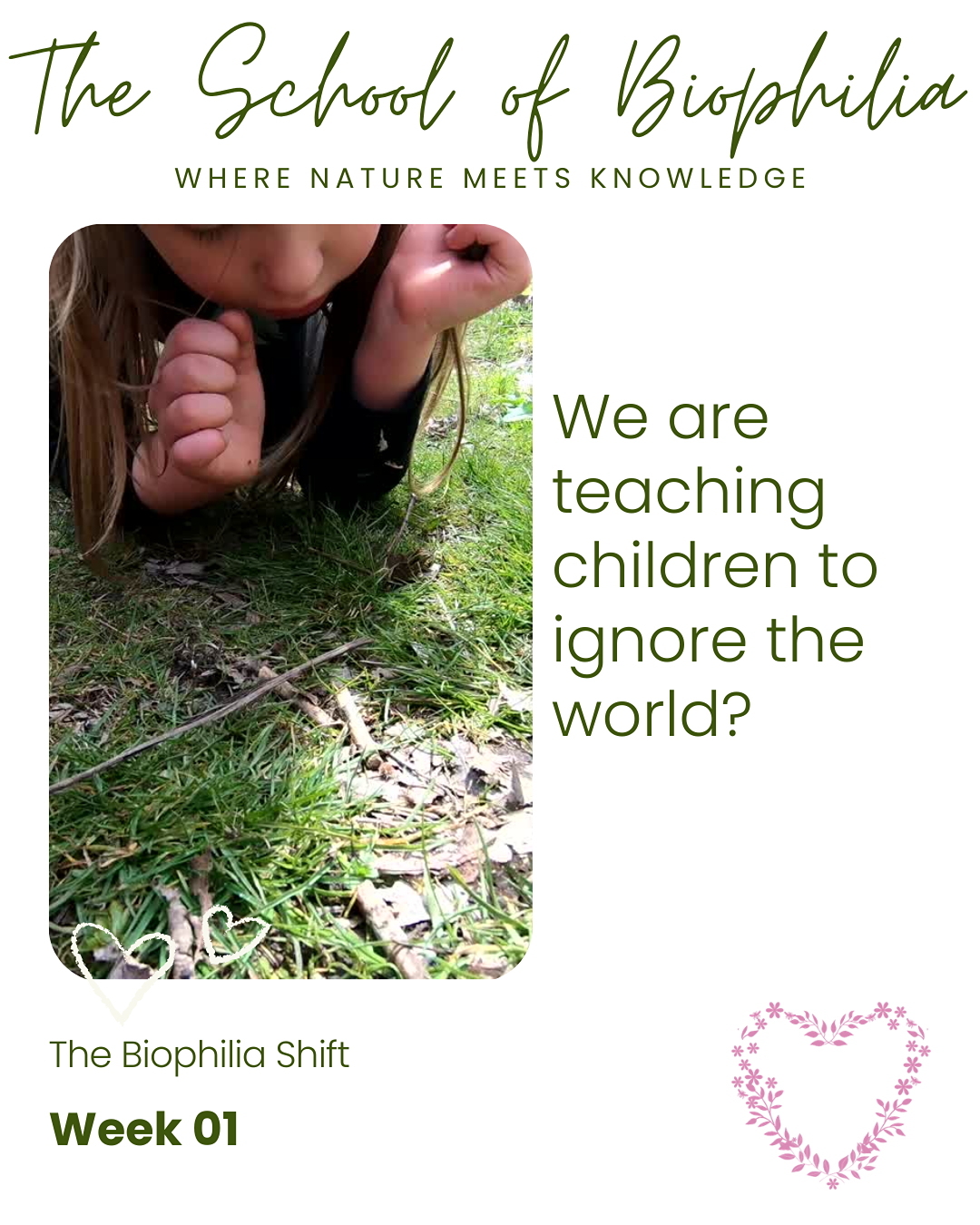
Week 01 of 12
We want to writing a book about why biophilia needs to sit at the heart of education, not as an add-on, but as a foundation.
For too long, nature has been treated as something we visit occasionally. A forest school session. A break from “real learning.”
But what if connection to nature isn’t extra, what if it’s essential?
Over the next 12 weeks, we’re exploring how biophilia shapes the person, (The child, the teacher and the parent), the classroom, and the curriculum and what needs to change if we are serious about creating environments where children can truly thrive.
Your reflections are helping shape this work. So please engage.
THE QUESTION
This week’s question:
What does a good day feel like for a child and what does that tell us about what education should be?
CONTEXT
Ask most adults what a “good day” looks like in school and you’ll hear words like productive, focused, settled, maybe even quiet.
Ask a child, and the answer shifts.
A good day is not measured in outputs. It is felt.
It lives somewhere between curiosity and comfort. Between movement and stillness. Between being held and being free.
And yet, much of our education system is designed in ways that interrupt this. Artificial light that flattens the day. Air that is stale. Noise that hums constantly in the background. Spaces that prioritise control over curiosity.
We talk about behaviour, attainment, outcomes, but rarely do we ask the simpler, more revealing question:
What does it actually feel like to be here?
Because feeling is not a distraction from learning.
It is the condition for it.
THE THREE SCALES
The Person
A good day begins in the body. A child who is calm enough to focus, alert enough to engage, and safe enough to explore is already in a state where learning can happen. Regulation is not something separate from education. It is the starting point.
The Classroom
The environment is not neutral. It is constantly signalling: sit still, be quiet, don’t touch, or move, explore, look closer. Light, air, texture, sound, these are not background conditions. They are active participants in the learning experience.
The Curriculum
If nature only appears occasionally, it is framed as optional. If it is embedded, it becomes a lens through which everything is understood. A good day suggests a curriculum that connects, not fragments.
BIOPHILIC LENSES
Nature in the Space: Is there daylight, fresh air, natural materials, living elements?
Natural Analogues: Are there patterns, textures, rhythms that echo the natural world?
Nature of the Space: Does the space offer refuge, prospect, movement, and moments of curiosity?
A good day often happens where these quietly align.
TEACHERS
Why This Matters
Teachers are often asked to manage behaviour, deliver content, and meet outcomes, all within environments that may be working against them. When a child struggles to focus, we tend to look at the child. When a class becomes unsettled, we look at routines or expectations.
But what if the environment is part of the story?
A classroom with poor air quality can increase fatigue and reduce concentration. If you want to data/research then let us know and we will make sure we are adding links. Harsh lighting can create discomfort. Constant noise can elevate stress levels. These are not minor issues, they shape how children behave and how teachers experience their day.
Biophilia offers a different lens. Instead of asking, “How do we control this group?” we begin to ask, “What conditions support them?”
Natural light can help regulate circadian rhythms, improving alertness and mood. Access to views or natural elements can reduce stress. Even small shifts, introducing plants, varying textures, creating quieter corners can begin to change the tone of a space.
This is not about creating perfect environments. It is about recognising that teaching does not happen in isolation from space. When the environment supports regulation and curiosity, teachers spend less time managing and more time engaging.
A good day is not just good teaching.
It is good conditions for teaching.
CHILDREN
How It Feels
A good day doesn’t announce itself. It unfolds.
It might start with light coming through a window, soft and changing, not harsh or fixed. A space that feels warm but not stuffy. Air that moves. Sounds that are not overwhelming. There is somewhere to sit quietly. Somewhere to look out. Somewhere to move.
Nothing feels too tight or too loud or too bright.
There are things to notice, textures, shadows, small details. A plant that changes over time. Materials that feel different in your hands. Spaces that invite you in rather than push you away. You can concentrate, not because you are told to, but because nothing is pulling you out of it.
You can be still, and you can move. You feel comfortable enough to be yourself. Curious enough to try. Safe enough to get something wrong.
A good day is not about everything going right.
It is about nothing constantly going wrong in the background.
PRACTITIONERS / PARENTS
How to Apply It
You don’t need a full redesign to begin.
Start with noticing.
Where do children naturally go in a room?
Where do they avoid?
When do they become restless, and what is happening in the environment at that moment?
Look at light.
Can you use it differently? Open it up? Soften it?
Look at air.
Is the space stuffy by mid-morning? Can windows be opened more regularly?
Look at sound.
Are there constant background noises that could be reduced? Are there quieter zones?
Look at materials.
Are children surrounded entirely by hard, synthetic surfaces? Can you introduce variation, wood, fabric, natural textures?
Look at layout.
Is everything fixed and controlled, or is there room for movement and choice?
And then think about the day itself.
Are there moments of pause?
Are there opportunities for outdoor connection that feel meaningful, not tokenistic?
Is nature something children engage with daily, or occasionally?
Teaching biophilia does not begin with a lesson.
It begins with conditions.
Small shifts, consistently applied, can begin to reshape how a space feels — and how children respond within it.
CALL TO ACTION
Read the full series and follow the journey here - we are going to post weekly, on a Tuesday - as there are lots of Bank Holidays in the coming weeks!
CLOSING
We’re writing a book about why biophilia belongs at the heart of education shaping the person, the classroom, and the curriculum - (and our logo)
Your thoughts are helping build it.
Comments